Two jobs that look similar and are not.
Managing your own estate and managing other people’s estates place opposite demands on the same software. One platform does both, without either feeling like an afterthought.
For managed service providers
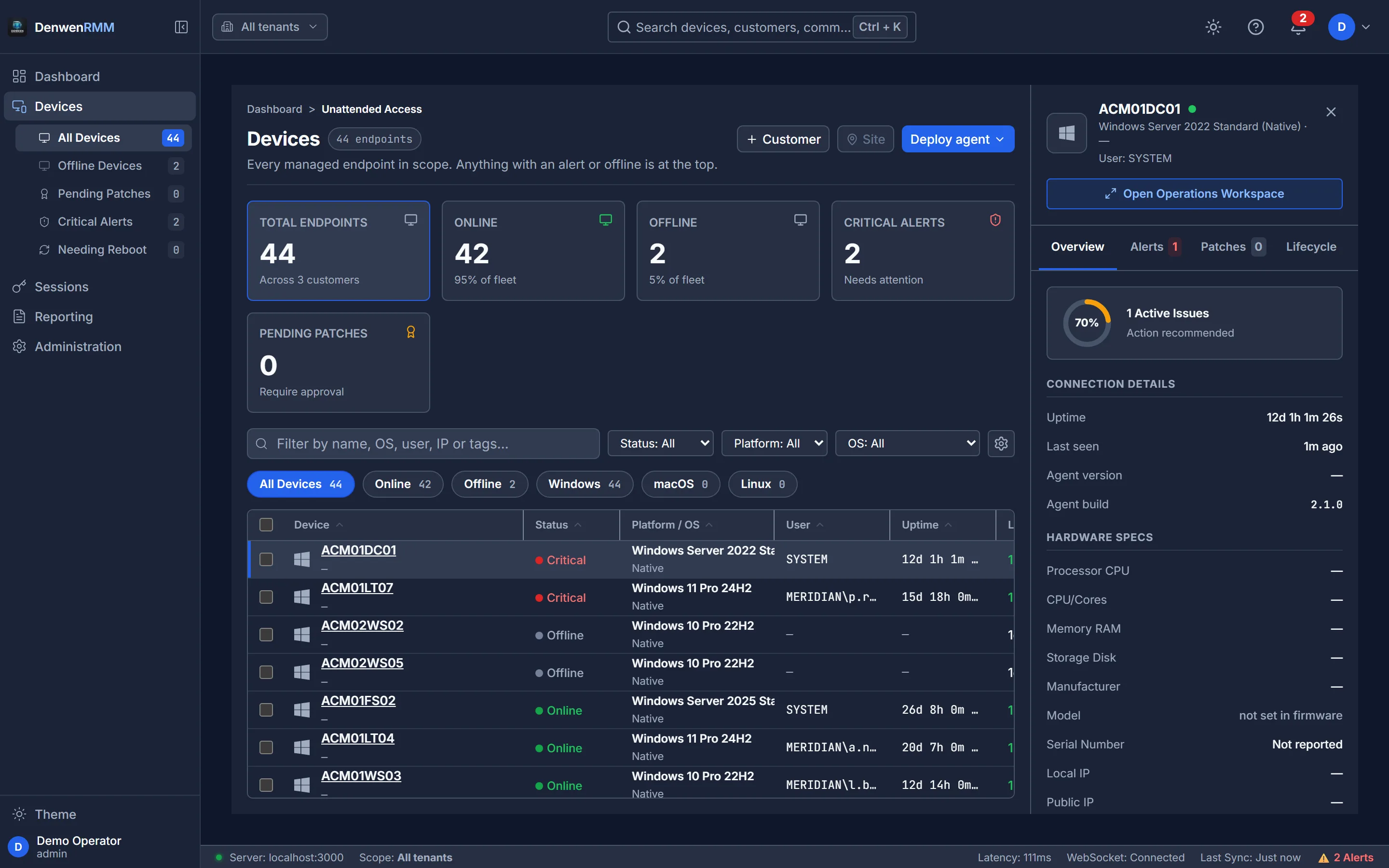
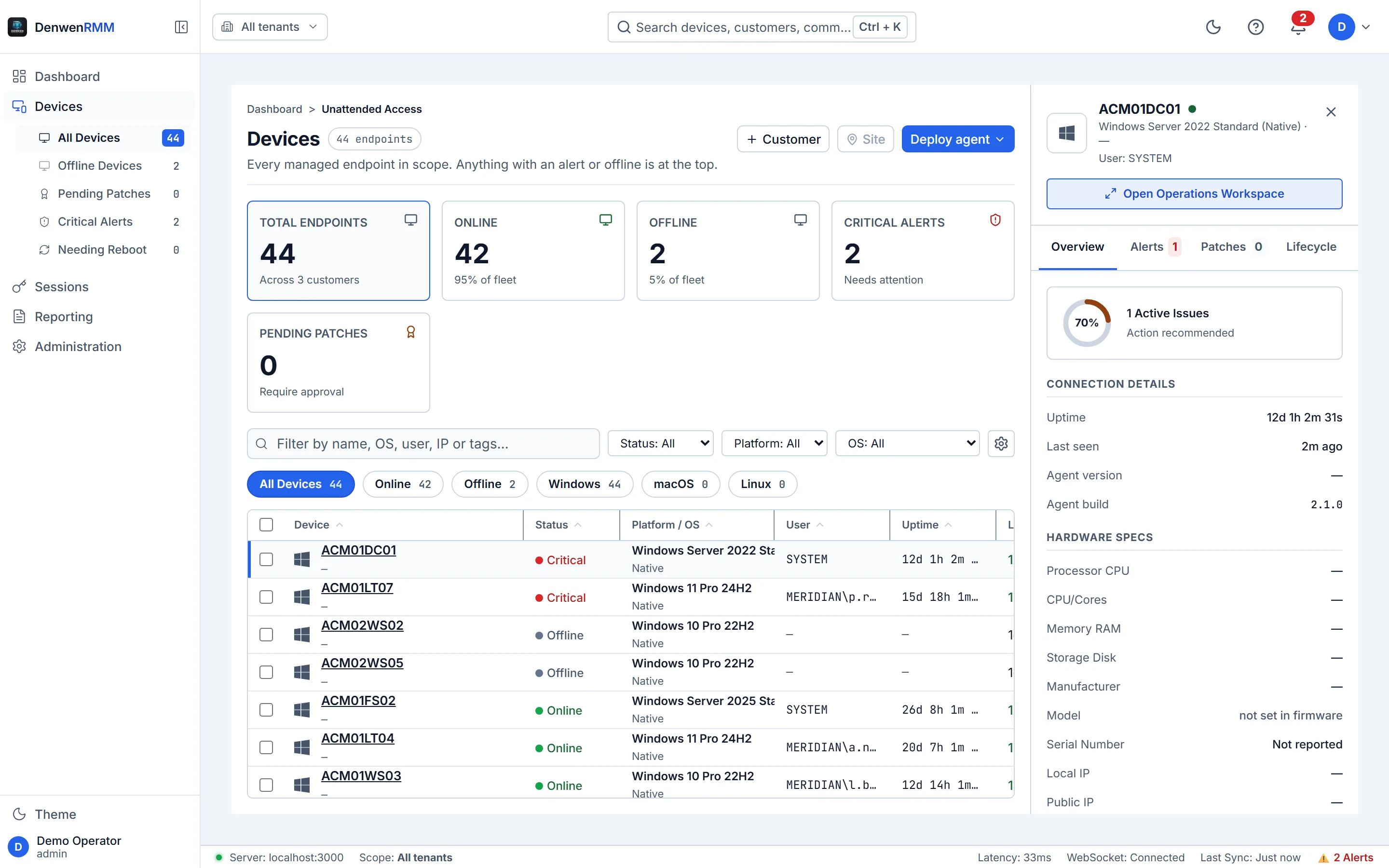
You are not managing one estate, you are managing thirty, and the thing that ends a contract is not a missed patch — it is one client seeing another client’s data. The tenancy model here is built for that, and the boundary is enforced in the query rather than applied to the results.
- Unlimited tenants, each with its own customers, sites and operators
- A technician scoped to one client cannot establish that another exists
- Per-tenant alert rules, mail relay, retention policy and identity provider
- Client-facing roles you define, scoped to specific sites
- A tenant hierarchy when you resell through partners
- Onboard a client in an afternoon: one tenant, one site, one installer
The commercial part
Price is per endpoint, not per technician, so growing a team does not cost more and taking on a large low-touch client does not become uneconomic. Volume bands are published, so a bid can be priced without a call.
An uninstalled endpoint stops counting the day it is uninstalled — not at renewal. You are billed for what you manage, when you manage it.
Start smaller than you think
Essentials has no tenancy to model and no hierarchy to design. Create a site, download the installer, put it on the estate. The patch position of every machine is a screen you open rather than a spreadsheet somebody maintains.
If you later become the team that supports two other companies, the tenancy is already there — you move up a tier rather than migrate platform.
For internal IT teams
One organisation, one estate, and a small team who would rather spend the afternoon on something other than walking to a machine that will not update.
- The patch and reboot position of every machine, continuously
- Remote control without asking a user to install anything
- Scheduled maintenance that runs at 02:00 without anybody being awake
- Software inventory for the licence audit you will eventually be asked for
- Alerts that reach a person, with a record proving they were sent
Estates where the answer has to be evidenced.
These are capabilities that map onto a duty. They do not make an organisation compliant — that depends on contracts, notices and lawful basis, none of which live in software.
Healthcare
Session recording with a notice the patient-facing user actually sees, retention capped and enforced, and the option to point AI at a model inside your own network so no prompt reaches a vendor you hold no contract with.
Legal and financial
An append-only audit trail the database enforces, per-tenant retention with a stated justification, and AI that can be pointed at a model you hold a contract with.
Education
Large estates, thin budgets and shared devices — per-endpoint pricing with published volume bands, and nothing to buy, rack or maintain beyond the endpoints themselves.
Manufacturing and OT-adjacent
Maintenance windows that respect a production line, Wake-on-LAN before the window rather than after, and patch detection everywhere even where remediation is not permitted.
Multi-entity groups
A tenant per subsidiary with its own operators and policies, under a hierarchy that lets a central team see across without each subsidiary seeing sideways.
Tightly egress-controlled
One outbound destination on 443 and no inbound rule at the endpoint, so the firewall change is a single allow-list entry your security team can read in full. Fully air-gapped estates are not a fit — the platform is hosted, and an endpoint with no route out cannot be managed.
See it on your own estate
A trial runs on your real endpoints, not a sandbox, and needs no payment details. Install the agent on ten machines and judge it on what it reports back.